
In This Article

- Word of mouth is your most powerful marketing channel — and social media is the fuel that keeps it burning longer.
- 64% of consumers discover small businesses through personal recommendations. That beats social media at 49% — but 83% of satisfied customers never refer anyone because nobody makes it easy for them.
- After reading this, you’ll know exactly how to combine word of mouth and social media into one lean system that gets you new customers without doubling your workload.
Word of mouth marketing for small business is the highest-ROI channel most owners already have — and the one they’re least likely to have a real system behind. Social media, done right, is what keeps referrals flowing between new customers. The two aren’t competing. They’re gears in the same engine, and most owners are only running one of them.
I hear this constantly: “My referrals are great, but my social media feels like shouting into the void.” Or the reverse: “I’m posting every day, but I’m not getting any new customers.” Both frustrations have the same root cause. You’re treating these as separate campaigns when they’re designed to reinforce each other.
Here’s what the research shows — and more importantly, what to do about it this week.
Why word of mouth marketing outperforms social media for finding new customers
New research from CommBank (May 2026) found that 64% of consumers discover small businesses through personal recommendations. Social media came in at 49%. And a University of Maryland study found the long-run impact of word-of-mouth marketing is 20 times greater than event marketing and 30 times greater than media appearances.
Nielsen’s data confirms what your gut already tells you: 92% of consumers trust recommendations from friends and family over all forms of advertising. Nothing you post will ever replicate that.
This is great news. It means the marketing channel with the highest ROI is completely free, requires no ad budget, and gets more powerful the better you treat your customers. The challenge is that it’s also invisible, inconsistent, and impossible to scale without a system.
That’s where social media comes in — not as a replacement, but as the infrastructure that makes word of mouth repeatable. Think of word of mouth marketing as the spark and social media as the kindling that keeps it going.
What social media actually does for small business (it’s not what you think)
Most small business owners measure social media by leads generated. By that metric, it almost always disappoints. The business owner on Reddit’s r/smallbusiness who reported their cost-per-click jumping from $0.23 to $6.24 in twelve months with the same budget and audience? That’s not unusual. Facebook ad ROI has dropped from roughly $4 to $1.75 per dollar spent in recent years.
But that’s the wrong scorecard.
Social media’s real job for a referral-driven business is credibility validation. When someone hears about you from a friend, the first thing they do is check your social profile. A dead feed — no posts for two months, no responses to comments — kills trust before a conversation even starts.
Social media’s second job — the one most people miss — is staying top-of-mind for people who are already fans. Your happy customers follow you. They see your content regularly. When someone in their network says “Do you know a good [whatever you do]?”, they remember you because you’ve been in their feed all week.
Word of mouth doesn’t happen once and then disappear. Research shows the impact of referrals can continue influencing new business for up to three weeks after the initial recommendation, while traditional marketing effects last only three to seven days. Consistent social posting extends that window.
How to make word of mouth marketing and social media work as one system
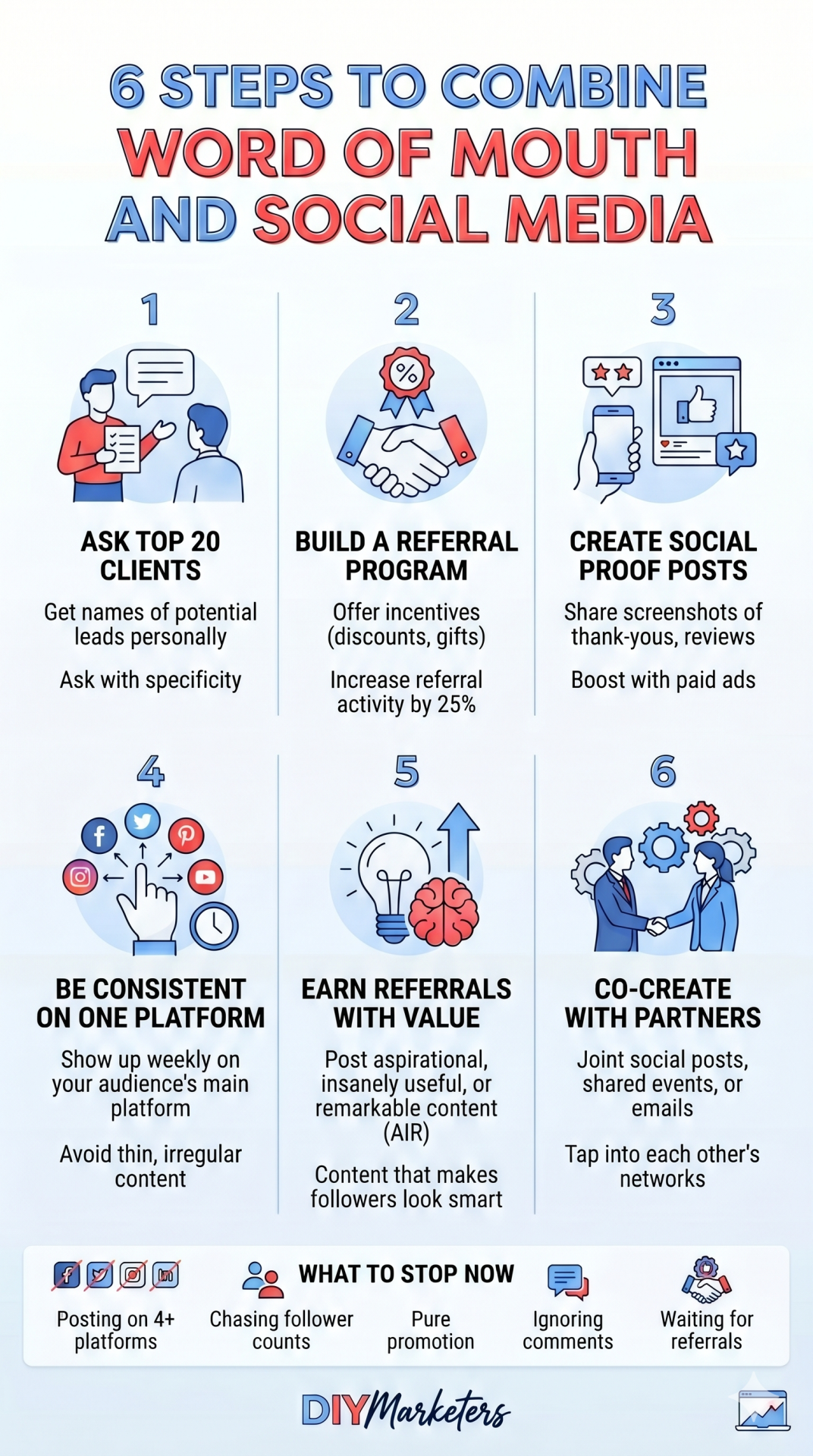
Here’s the system I walk clients through. It’s six moves, not sixty. Pick the ones that match where you are right now and start there.
1. Ask your top 20 customers directly
This is the move almost every small business owner skips because it feels awkward. Get over it. Make a list of your 20 most satisfied customers and ask them — in a real conversation, not a mass email — if they know anyone who might benefit from what you do.
One business owner in Reddit’s small business community reports 80% of his revenue comes from pure referrals with zero advertising spend. His secret? He asks. Every time. With specificity: “Do you know anyone in [specific situation] who might need what you got from me?”
The specificity matters. “Send me referrals” is a request. “Do you know any restaurant owners who are struggling with their social media?” is a prompt that actually triggers names.
2. Build a referral program (yes, even a simple one)
83% of satisfied customers say they’re willing to refer. Only 29% do. The friction between those two numbers is your revenue opportunity.
Referral marketing delivers 3 to 5 times higher conversion rates than other acquisition channels. Referred customers have a 37% higher retention rate. They’re 5 times more likely to convert. And offering a simple incentive — a discount, a gift card, a free month — increases referral activity by up to 25%.
You don’t need software to start. A shareable link, a simple “tell a friend” email, and a thank-you gift for anyone who sends business your way is enough. Once you’ve seen it work, you scale it. Check out the DIYMarketers guide to getting customers to share your business for the exact templates.
3. Turn customer stories into social proof posts
User-generated content increases trust by 2.4 times over branded content. Every time a customer tags you, reviews you, or sends you a thank-you message, that’s an asset — not a nice moment to acknowledge and forget.
Screenshot it. Share it. Ask permission and post it with context: “Here’s what happened after [customer name] worked with us for 60 days.” Then take that post and boost it with a small paid budget to extend its reach beyond your existing followers.
This is the move that turns organic word of mouth into scalable social proof. You’re not creating content from scratch — you’re amplifying what happy customers are already saying.
4. Pick one platform and be consistent on it
Reddit’s small business community in 2026 is unanimous on this: pick one platform where your target audience is active and be minimal and consistent. More than 75% of small businesses agree social media positively impacts business performance — but only when used with strategic focus, not scattered across five platforms with thin, irregular content.
The algorithm rewards consistency. More importantly, your audience does too. Showing up every week on LinkedIn or Instagram or Facebook — whatever platform your best customers actually use — signals stability and professionalism. That’s what converts a warm referral into a booked client.
If you’re not sure which platform to pick, ask your last five customers where they spend time online. Go where they already are.
5. Post content that earns referrals, not just likes
WOM researcher Nicholas Reese’s AIR framework is the best filter I’ve found for this. Content earns sharing when it’s Aspirational (makes the sharer look smart or generous for passing it along), Insanely Useful (helps someone the sharer cares about), or Remarkable (too interesting or surprising not to share).
Vanity posts — “Happy Monday!” and product photos with no context — get likes. AIR content gets referrals. And 68% of consumers say they share brands that make them look good or knowledgeable to their networks. Write content that makes your followers look smart for following you and they’ll do your marketing for you.
For a deeper breakdown of how to ask for referrals without feeling pushy, that guide covers the exact language to use.
6. Co-create content with local partners
If you already have local partnerships that are driving business, you’re sitting on an untapped content asset. Research shows deals are 53% more likely to close when a partner is involved and close 46% faster. That trust transfer is real — and it works on social too.
Ask one local partner to do a joint post, a shared event announcement, or a collaborative email monthly. You each get the other’s audience. Your referral network grows, expanding your network connections. The partnership deepens. And you’ve just doubled your content output without doubling your time.
This is especially effective when you tag each other and engage with each other’s communities. It signals to both audiences that you’re embedded in a trusted network — which is exactly the social proof that turns strangers into buyers.
What to stop doing right now
Rather than adding more to your plate, cut these first. They waste time with zero payoff for either word of mouth or social media:
| The Habit | Why It’s Killing You | What to Do Instead |
|---|---|---|
| Posting on 4+ platforms | Thin, inconsistent presence everywhere | Own one platform completely |
| Chasing follower counts | Followers don’t pay bills, buyers do | Track saves, shares, and DMs instead |
| Pure promotional posts | Nobody shares ads with their friends | Use 80% value, 20% offer content |
| Ignoring comments | Kills trust faster than a dead feed | Reply within 24 hours, every time |
| Waiting for referrals to happen | 54-point gap between willing and doing | Ask your top 20 customers this week |
The one-week starter plan
If you’re reading this and thinking “I don’t have time for a whole new system,” here’s where to start in the next seven days.
Day 1–2: List your 20 most satisfied customers. Reach out to five of them personally and ask who they know. No mass email. No template. A real conversation or a personal message.
Day 3–4: Pull any testimonials, reviews, or thank-you messages from the past 90 days. Turn the best three into social posts. Schedule them for the next two weeks.
Day 5–7: Pick your one platform. Commit to showing up there twice a week for the next 30 days. Set a calendar reminder so it’s not optional.
That’s it. No new tools required. No ad budget needed. Word of mouth marketing for small business works on exactly this kind of focused, personal energy — not spray-and-pray posting. The best small business marketing budget move you can make is putting your energy where trust already exists and giving it a system to grow.
If you’re trying to figure out which marketing strategy vs. tactics to prioritize, the short answer is: strategy first, always. Word of mouth is the strategy. Social media is the tactic that makes it scale. Get that order right and everything else gets easier.
And if your referral marketing has hit a wall — or never quite got traction in the first place — the breakdown usually happens in one of three places. The guide to why referral marketing stops working walks through each one with specific fixes.
Frequently asked questions about word of mouth marketing for small business
Is word of mouth better than social media for small businesses?
For most small businesses, word of mouth consistently outperforms social media as a primary source of new customers. Research from CommBank (May 2026) found 64% of consumers discover small businesses through personal recommendations, compared to 49% via social media. Nielsen data confirms 92% of consumers trust recommendations from people they know over any form of advertising. That said, “better than” isn’t the right frame — word of mouth and social media work best as a system, not as competitors. Social media validates the referral once a prospect looks you up, keeps satisfied customers engaged so they remember to recommend you, and amplifies the stories your happy customers share.
How do I use social media to increase word of mouth referrals?
The most effective approach is treating social media as your word-of-mouth amplifier rather than a lead generator. Post customer success stories and testimonials regularly — user-generated content builds 2.4 times more trust than branded content. Make it easy for satisfied customers to share by tagging them in posts, creating content that makes them look smart or generous for forwarding it, and responding to every comment and message. Research shows 68% of consumers share brands that make them look knowledgeable to their networks. Post content that delivers that feeling and your customers become your unpaid marketing team.
What is a simple referral program for a small business with no marketing budget?
Start with three elements: a reason to refer (usually a small incentive like a discount, gift card, or free consultation), a simple mechanism (a shareable link or a direct “tell a friend” message), and a consistent ask (reaching out to your top satisfied customers personally and asking who they know). Research shows offering incentives increases referral activity by up to 25%, and keeping the process simple is the biggest driver of participation. You don’t need software to start — a personal message and a thank-you gesture for any sent referral is enough to launch. Once you see results, you can invest in a more formal system.
How often should a small business post on social media?
Consistency matters more than frequency. For most small business owners, posting two to three times per week on one platform outperforms daily posting spread across multiple platforms. The algorithm rewards consistency, and more importantly, so does your audience. A feed with regular, valuable content signals stability and credibility — which is what converts a warm referral into a paying customer. More than 75% of small businesses report that social media positively impacts their business performance, but only when used with strategic focus rather than scattered, irregular effort.
Can word of mouth work for a business with no existing customers?
Yes, but you have to manufacture it intentionally. Without an existing customer base, you build word of mouth through strategic partnerships with local businesses whose customers overlap with yours. Research shows deals close 53% faster and are 46% more likely to succeed when a partner is involved — that trust transfer works for referrals too. Start by identifying two to three businesses that serve your ideal customer but don’t compete with you directly. Propose a co-marketing arrangement: joint social posts, cross-referrals, or a shared event. Their customers become aware of you through a trusted source, which is the same mechanism as a personal recommendation.